
When a person experiences a profound and life-altering loss, he or she routinely proceeds through the five stages of grief (denial, anger, bargaining, depression, and acceptance). Each of us experiences these stages in different proportions, according to our own unique circumstances, but broadly speaking, these five stages serve as a reliable template for a grief journey.
The final step–acceptance–is a tricky one. What is that supposed to mean? Does it mean that one can expect to reach a stage where the grieving is done, closure is complete, and forward movement can continue unhindered? It may be tempting to idealize the concept of acceptance this way, but doing so will leave you frustrated with horribly misplaced and consistently unfulfilled hope.
Rather, acceptance is that stage where forward movement continues, but in a way that does not close the door on the past, nor on the particular loss. Acceptance walks in peace, but it does so knowing that the current path is quite different from the one that would exist in an alternate timeline where the loss never happened. Acceptance doesn’t let go of the loss, but it carries the loss thoughtfully and informingly into an equally uncertain future.
The Persistence of Memory
As of this writing, it’s been over two years since my wife Angela entered into eternal victory. Since that time, I’ve had countless moments of reliving memories, reflecting on milestones that my son and I now experience without her, and even scripting new would-be conversations that might happen if she were still here.
Most of these moments bring me a measure of peace as they evoke my fondest memories of my wife. But sometimes, a more intense feeling may arise. One that doubles back and relives an earlier stage of the grief journey. Last year, I wrote about one such moment during the Sunday morning worship service a week before I released my memoir, The Widower and the Washer.
Last week I experienced similar, if less intense, moment during what on the surface may seem an unlikely venue for such a profound moment: at a Demon Hunter concert.
A Moment in the Making
Before I get into the concert itself, I need to take an aside. For some time now, I’ve contemplated writing an entry about how impactful and beneficial Demon Hunter’s music has been for me in recent years. Now seems like the appropriate time to do so.
I first discovered Demon Hunter 20 years ago when I heard Deteriorate on Christian rock radio. This is a contemplative song about persevering while time and aging wear on the body, mind, and spirit. In the years that followed, I continued to enjoy their radio releases and even picked up some CDs along the way. When streaming music became the norm, I added my favorite Demon Hunter tracks to assorted playlists.
Then in 2022, Demon Hunter began releasing tracks from their upcoming album, Exile. I heard Silence the World, a song about seeking refuge from the noise of the Information Age (particularly social media), for the first time and it resonated deeply. Perhaps it was because that summer was the peak of Angela’s struggle with anxiety. Or maybe the band’s use of 3/4 time (not common in heavy metal) made the tune hit differently.
Regardless of the reason, that summer I spent my listening time reacquainting myself with my favorite Demon Hunter tunes while also getting to know the ones I had somehow missed along the way. By the end of the year, they had claimed the “most played artist” spot on my preferred streaming platform and have stayed there ever since. With a 20+ year history, it seemed they had a perfect song for just about any occasion, mood, or sentiment.
Prelude
I recall one particular Sunday afternoon in January 2024. The discussion from that morning’s adult Sunday school class prompted me to share a Demon Hunter song on social media. I posted the lyric video for Fear is Not My Guide, a rare piano piece about standing firm in faith and unashamed in the face of one’s own mortality, in a forum for church members. I captioned the post with “I don’t know who needs to hear this but I’m compelled to share it”.
I could not have known at the time that I was the one who needed that song. It was only a couple of weeks later that I would say my final goodbyes to Angela.
In the weeks and months that followed, as I navigated the not-at-all-linear path through the stages of grief, I played the aforementioned songs on repeat, alongside newly discovered favorites that spoke to a wide range of thoughts and emotions. Whether I was wrestling with the loneliness of a quiet house (Loneliness), a misplaced feeling of abandonment (God Forsaken), a hope to see God use my trials for His glory (Blood in the Tears), or just plain mourning (Dead Flowers), I found a Demon Hunter song for every moment.
Then, in the summer of 2025, Demon Hunter began to release new music that spoke more deeply into my circumstance.
There Was a Light Here
Demon Hunter’s 2025 album, There Was a Light Here was born from grief and mourning, as lead singer Ryan Clark wrote several songs about his recent loss of his mother. The new songs quickly made their way into heavy rotation on my playlists. I also started keeping an eye out for upcoming live shows, since a new album meant a new concert tour.
Earlier this year, my oldest son reached out to see if I would want to go to the Demon Hunter show that was coming our way on his birthday. It was a weeknight, which meant I would need to arrange coverage for my teenage son, but it seemed that this tour, in this season, was the right moment to see Demon Hunter live for the first time.
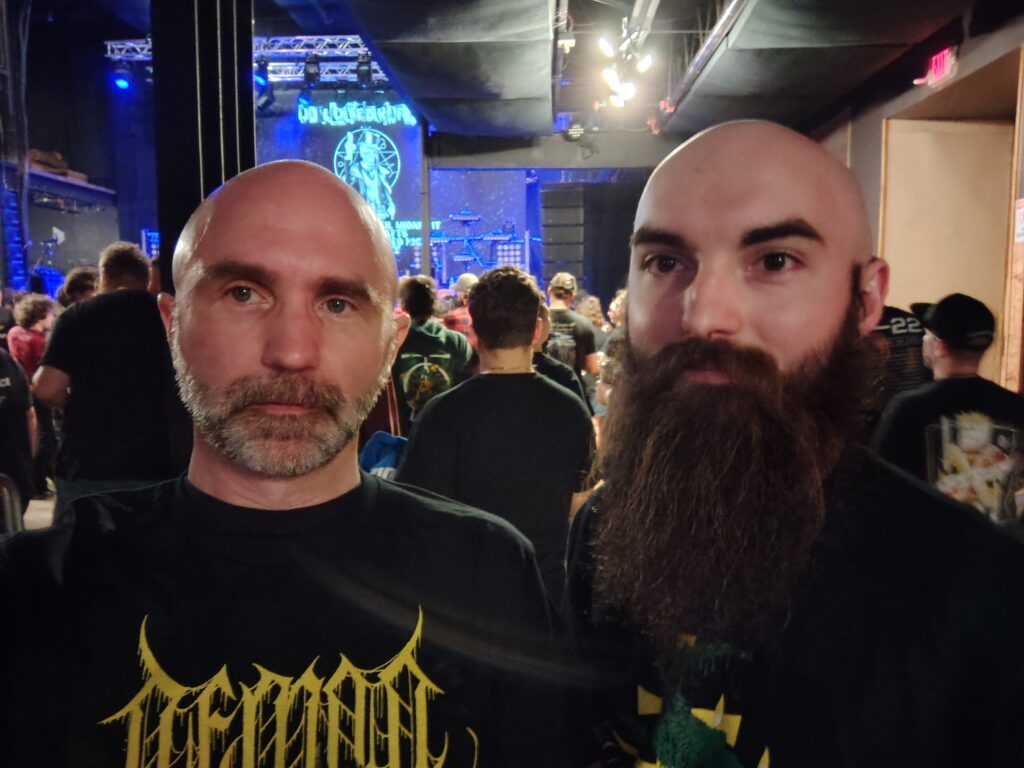
May 5 arrived and I found myself standing in a concert venue in Harrisburg alongside my firstborn. (Quick aside–it was cool to see so many graybeards out enjoying a concert with their teen and twentysomething sons–I really felt like I fit in.) On some level, knowing how much I’ve leaned on Demon Hunter’s music, and knowing which songs I could expect to hear, I was prepared for an emotional moment or two. I even warned my son to expect such a moment.
Dead Flowers
Still, when the time came, it was more profound than I could have anticipated. More than halfway through the set, I heard the four-note introduction to Dead Flowers, and took a moment to be still and listen. My eyes dampened at the first chorus and I was lost in the music as the song proceeded through an instrumental interlude, a subtle key change that evoked a sense of hope, and landed with an extended audience singalong.
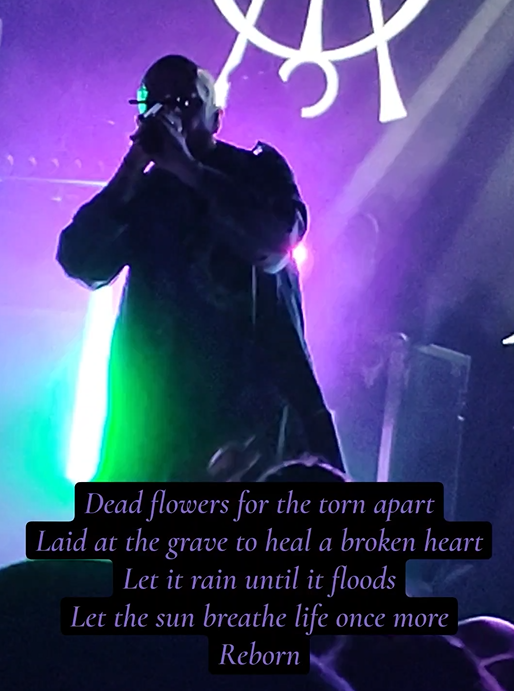
Before beginning the next song, Ryan Clark shared the story behind the song. It was the track that completed their latest album (and provided the album title), but more importantly, it was the song that he wrote to honor his mother, a song provided something that, up until that point, he said, had been missing from the album.
Dead Flowers had already primed the pump. When I heard the first chorus of There Was a Light Here, the tears flowed. And there I stood, with my arm across my son’s shoulder–and his arm across mine–crying at a heavy metal concert.
And surrounded by people who get it.
But as Christians, we don’t mourn the way the world mourns. The sadness we experience is real, but it is also accompanied by hope. So, let’s take a moment to unpack some lyrics and consider the hope within.
Let There Be Light
Here is the chorus to There Was a Light Here:
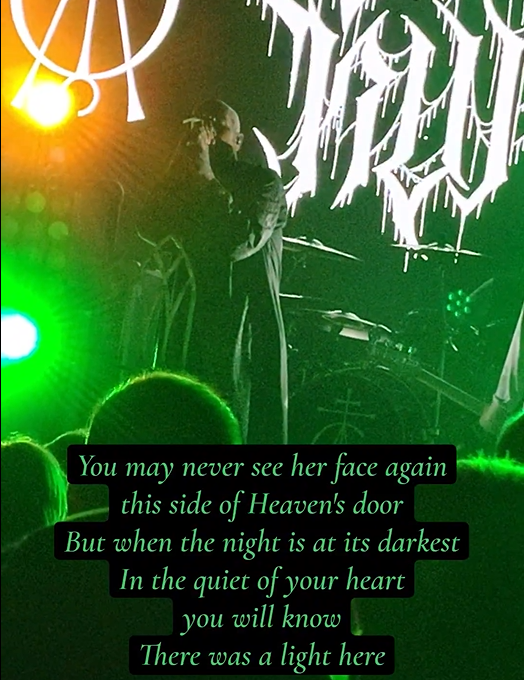
The imagery is obvious. The extinguished light correlates to the end of an earthly life. The reference to Heaven, of course, speaks to the hope of both resurrection reunion. Additionally, to me the light in this chorus speaks to the nature of the light that Angela carried, that Ryan Clark’s mother carried, and that other wives and mothers–no doubt remembered by other audience members in the same moment–carried. My mind went to the following verse:
God made two great lights—the greater light to govern the day and the lesser light to govern the night. – Genesis 1:16a
From the beginning, when God first created light, He established a lasting and bright light source, accompanied by a secondary light for the dark times. Scientifically we know that the moon does not emit light, it merely reflects the light of the sun. But before this moment, I had never considered how the relationship between the sun and moon reflects (pun intended) the relationship between Christ and his church.
Jesus is the light of the world (John 8:12). In him and through him, all who know him are conduits of his light (Matthew 5:14). Apart from Jesus, we know only darkness. Yet despite our fallen nature, in his redemptive grace, he calls and commissions us to bear his light into the darkness for the sake of others (Ephesians 5:8). This is our ultimate and lasting hope.
Angela’s light was bright because it was a reflection of the light of the One who created her, redeemed her, and sustained her. She was blessed with 40 years to share that same light. My own light is brighter because of the work that the Holy Spirit did through her for my benefit. Angela’s light has now been joined in eternity to the Light that will never dim.
And I pray that as I live out my time here, God may continue to illuminate my path so that by His power, I might shine as brightly as Angela did.
